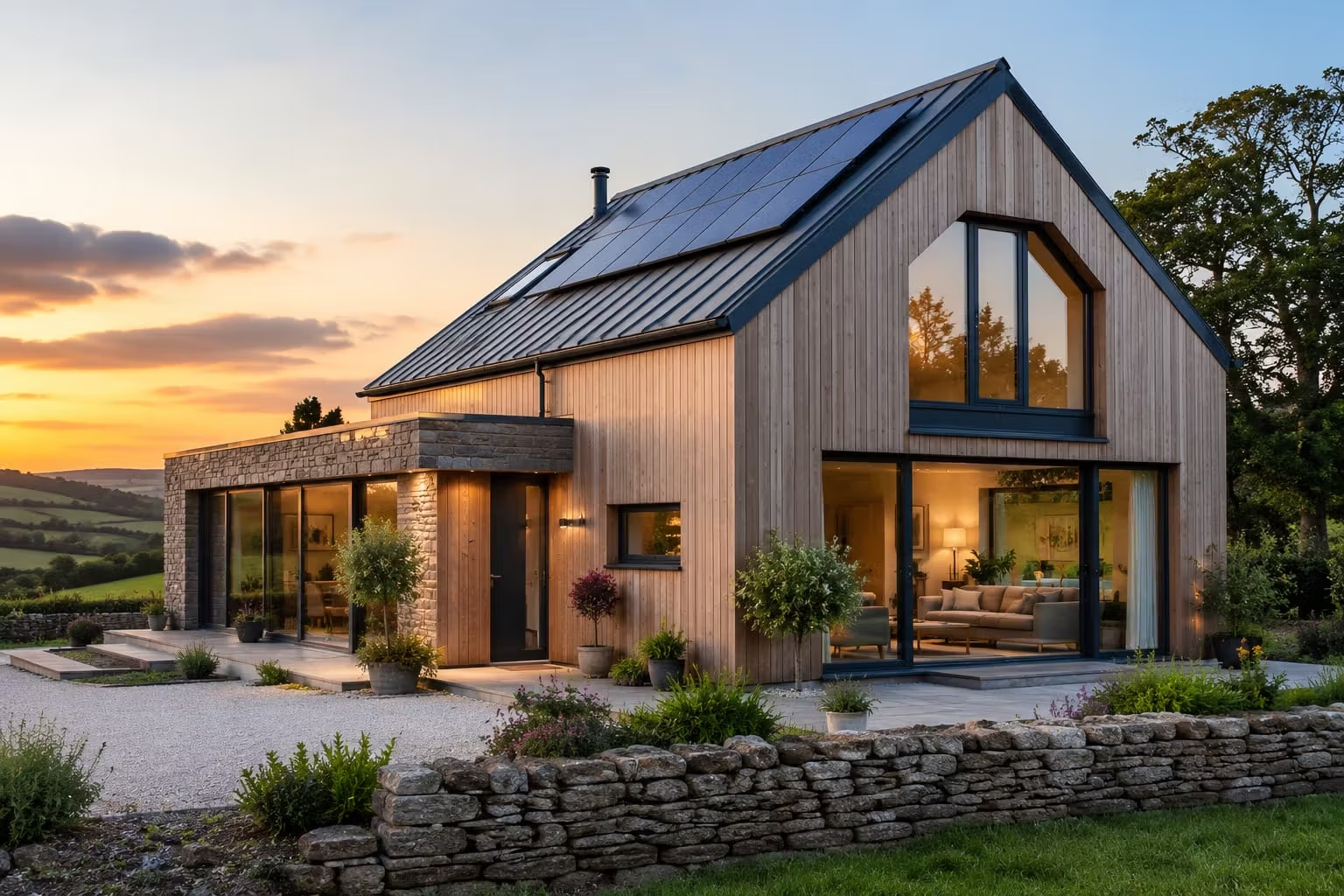
Residential Construction
What is a Passive House?
A Passive House (Passivhaus) is a building standard that achieves exceptional energy efficiency through superior insulation, airtight construction, thermal-bridge-free detailing, and mechanical ventilation with heat recovery (MVHR). A certified Passive House uses up to 90% less energy for heating than a standard new build — without relying on complex heating systems to compensate for a poorly insulated envelope.
Passive House is a performance standard, not a design style. It works with any architectural approach — contemporary, traditional, coastal, or rural.
Why Passive House Works So Well in Cornwall
Cornwall's Atlantic climate — wind-driven rain, salt air, coastal temperature swings — demands an envelope that's genuinely airtight and genuinely insulated. A Passive House eliminates the thermal bridges and airtightness failures that cause damp, mould, and cold spots in coastal homes. The result: warm, dry, and quiet through a Cornish winter, on a fraction of the energy a standard new build requires.
How Warvena Builds Passive House Homes
Passivhaus Trust Listed
Warvena is listed on the Passivhaus Trust directory — the UK’s authoritative register of builders with verified Passive House experience. Not every builder who claims Passive House experience appears on that list. We do.
Design Stage Involvement
Passive House certification is decided at design stage — airtightness strategy, MVHR integration, thermal bridge detailing, window specification. We work alongside architects from RIBA Stage 2, contributing the construction knowledge that makes a Passive House buildable and certifiable.
Airtightness & Thermal Bridge Detailing
The two most common reasons Passive House projects fail certification are airtightness failures and unresolved thermal bridges — both construction problems, not design problems. Our in-house tradespeople are experienced in the discipline airtight construction demands: methodical, no shortcuts at the membrane.
MVHR Installation & Commissioning
We manage MVHR specification, installation, and commissioning as part of the main build — not subcontracted at the end. Unit selection, ductwork sizing, and commissioning are all handled in-house.
Cornwall-Specific Procurement
Certified Passive House components carry 12–20 week lead times and must be sourced outside Cornwall. We identify and order early, aligned with planning consent, so the programme is never waiting on a delivery.
Passive House Projects in Cornwall
The Ark at Constantine Bay — a bespoke coastal new build where timber frame structure, airtightness layer, and bespoke coastal glazing had to work together to hit the performance targets. Every decision was made at design stage, not resolved on site under pressure. That’s how Passive House is built properly. Cogos Park — a Passive House build combining airtight construction with high-performance insulation to deliver a comfortable, low-energy home built for Cornwall's climate.
Forth an Ula — a coastal Passive House project where exposure to wind and salt air demanded careful detailing at every stage, from structure through to glazing and finishes.
Tehidy — a high-performance home designed around Passive House principles, prioritising airtightness and thermal comfort without compromising on design.
Three Mile Beach — a Passive House build on an exposed coastal site, where performance targets were built into the design from the outset rather than resolved on site.
Passive House Builders Across Cornwall
We build across the whole of Cornwall — coastal sites, AONB locations, rural plots, and urban infill. Bude and Padstow on the north coast to Falmouth, the Lizard, and Penzance in the south.
Planning a Passive House build in Cornwall?
Warvena Construction is listed on the Passivhaus Trust directory. TrustMark registered. AECB members. In-house tradespeople.
Get in touch → info@warvenaconstruction.co.uk | 01872 300856
Frequently Asked Questions About Passive House in Cornwall
What is a Passive House and how does it work?
A Passive House achieves up to 90% less heating energy demand than a standard new build through five principles: superior insulation, airtight construction, thermal-bridge-free detailing, high-performance windows and doors, and MVHR. It eliminates heat loss at the envelope level rather than compensating with a large heating system.
How much does a Passive House cost to build in Cornwall?
Typically 10–20% more than a standard new build — reflecting higher specification insulation, airtightness systems, triple glazing, and MVHR. Cornwall-specific factors (coastal uplifts, supply chain distance) add further. The additional cost is offset by dramatically lower energy bills and a building envelope that outperforms standard construction in Cornwall’s climate.
Do Passive House builders need to be certified?
Builders don’t require individual certification, but listing on the Passivhaus Trust directory indicates verified project experience. Warvena is listed. When choosing a builder, ask specifically about airtightness construction and thermal bridge detailing experience — these are where Passive House builds succeed or fail.
Is Passive House suitable for coastal sites in Cornwall?
Yes — and Cornwall’s coastal climate is one of the strongest arguments for building to Passive House standard. The airtight, thermally-broken envelope eliminates the damp penetration, cold bridging, and mould problems common in coastal homes built to building regulations minimum. On Atlantic-facing sites, it’s the appropriate response to the conditions.
Can a Passive House be certified after construction?
Yes, but it’s significantly harder and more expensive than designing for certification from the outset. Certification requires a blower door airtightness test on completion plus full design and construction documentation. It cannot be retrofitted — the airtightness discipline must be maintained throughout the build
THINKING ABOUT A PASSIVE HOUSE BUILD IN CORNWALL?
Warvena Construction are TrustMark registered builders based in Redruth, Cornwall. Listed on the Passivhaus Trust directory and members of the AECB, we build certified Passive House homes across Cornwall for private clients, architects, and developers.