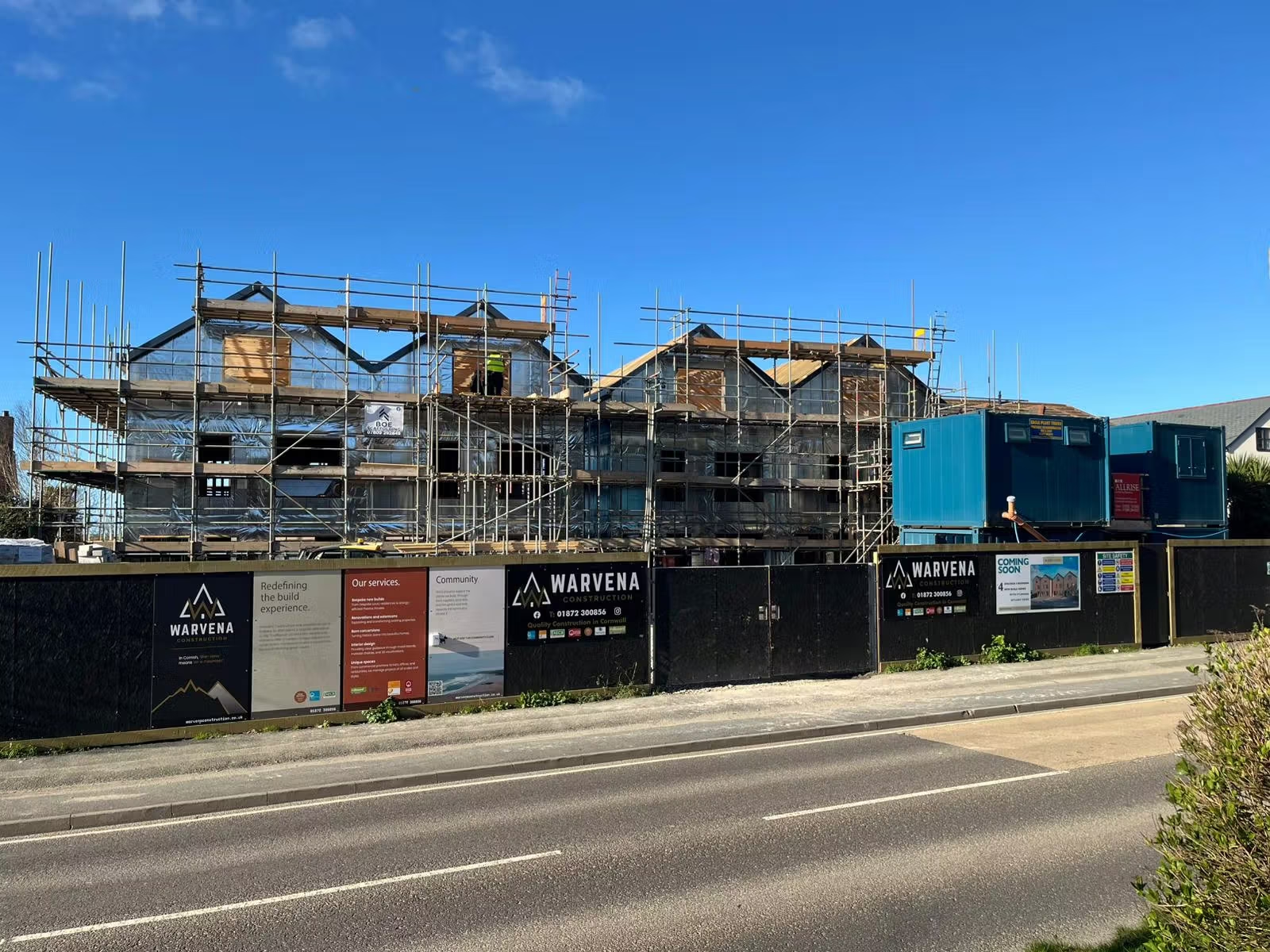
Why Choose Our New Build Services
Most new build problems aren't design problems. They're sequencing problems — a foundation decision made before the ground investigation came back, a window order placed too late to hit the weather-tight milestone, a planning condition nobody mapped against the construction programme.
We're a small, in-house team. Groundworkers, carpenters, and finishing trades employed directly, not subcontracted out to whoever's available that month. That matters more than it sounds. One team, accountable from the first trench to the final coat of paint, tends to catch the things that fall through the gaps between separate subcontractors who've never worked together before.
We've built on some of Cornwall's most demanding sites — granite bedrock that needed rock-breaking equipment, exposed coastal plots facing the full force of an Atlantic winter, land inside Areas of Outstanding Natural Beauty where every material choice gets scrutinised. That experience shapes how we approach every new build, regardless of where in the county it sits.
TrustMark registered. Listed on the Passivhaus Trust directory. Members of the AECB. None of those credentials build a house on their own, but they're a reasonable proxy for the kind of standards we hold ourselves to before anyone's watching.
Our New Build Process
1. Initial conversation and site assessment
Before any design work begins in earnest, we look at the site itself — access, orientation, any obvious ground or planning constraints, and what the brief is actually trying to achieve. This is also where early contractor involvement earns its keep: bringing construction knowledge into the room before the architect has finalised drawings tends to produce a more buildable result than design and pricing happening in isolation.
2. Design development and planning
Working alongside your architect, or supporting a self-build client's own design team, we contribute buildability input as the drawings develop — flagging anything that looks elegant on paper but is awkward or expensive to construct, before it's locked into a planning submission.
Pre-Construction Services Agreement
3. Ground investigation and structural strategy
Cornwall's ground is genuinely unpredictable across short distances. Granite at shallow depth in one spot, made ground or a high water table a few hundred metres away. A proper ground investigation — trial pits or boreholes — is what turns a guessed foundation cost into a real one, and it's commissioned before tender, not discovered once groundworks have started.
4. Planning permission and building regulations
Most new builds in Cornwall need full planning permission, and a separate building regulations application covers the technical construction standards regardless of the planning route. Cornwall Council typically determines householder applications within eight weeks of validation, with major applications closer to thirteen weeks. We map every planning condition against the construction programme as early as possible, since several conditions are pre-commencement — meaning they must be formally discharged before groundwork can legally begin.
5. Procurement and long-lead items
Bespoke triple-glazed windows, certified Passive House MVHR units, and engineered timber frame components can carry lead times of twenty weeks or more. Identified and ordered the moment planning consent is granted, these arrive exactly when the build needs them. Left until tender, they stall the entire programme.
6. Construction
Groundworks, structure, envelope, services, and fit-out follow in sequence, each stage inspected before the next begins. On exposed or coastal sites, the programme is built around Cornwall's weather patterns specifically — heavy groundworks and roofing scheduled away from the worst of the Atlantic storm season wherever the planning timeline allows it.
7. Handover and aftercare
Commissioning, snagging, and a defined defects period follow practical completion, with clear documentation handed over for anything the client needs to know about maintaining the finished home.
Types of New Builds We Construct
Bespoke architect-led new builds
One-off homes designed around a specific site, client, and way of living — no standard house types, no off-the-shelf specification. [Internal Link: Bespoke New Build Homes Cornwall]
Timber frame new builds
Faster programmes, strong thermal performance, and lower embodied carbon than masonry, with the structural flexibility to suit contemporary and architecturally ambitious designs. Timber Frame Construction Cornwall
Passive House new builds
Certified, ultra-low-energy homes built to a measured airtightness standard rather than a marketing claim — warm and quiet through a Cornish winter on a fraction of the energy a standard new build requires. Passive House Builders Cornwall]
ICF construction
Insulated concrete formwork offering exceptional thermal performance and structural strength, well suited to exposed coastal sites and complex architectural geometry. ICF Construction Cornwall
Self-build projects
Working alongside self-build clients and their own design teams, contributing construction expertise without taking over decisions that belong to the client.
Coastal and AONB new builds
Homes engineered specifically for Cornwall's exposure conditions and the planning constraints that come with the county's protected landscapes. Coastal Construction Cornwall
Contemporary and traditional homes
Modern, glazed, open-plan designs and homes built in a more traditional Cornish vernacular — stone, slate, and proportions that sit comfortably within an existing streetscape or rural setting.
Countryside and rural new builds
Often the most planning-sensitive category of new build in Cornwall, governed by specific rural exception policies and landscape character assessments that an experienced design and build team will already understand.
Why Build a New Home in Cornwall?
Cornwall's housing target is currently the second-highest in England, and the council has been explicit about wanting to build homes faster as part of its wider economic strategy — which, in practice, means the planning system here is under real pressure from both directions: a genuine appetite to approve good development, balanced against some of the country's most protected landscapes.
That tension is exactly why local knowledge matters. Over thirty percent of Cornwall falls within an Area of Outstanding Natural Beauty, and large parts of the county carry conservation area status, listed building designations, or Article 4 Directions that remove standard permitted development rights. None of that makes building here impossible — Cornwall approves a substantial volume of new homes every year — but it does mean the design and the planning strategy need to be right from the outset, rather than adjusted reactively after a refusal.
Beyond the planning landscape, Cornwall offers something genuinely difficult to replicate elsewhere in the UK: dramatic, varied terrain within a small geographic area. Clifftop sites with uninterrupted Atlantic views sit within an hour's drive of sheltered wooded valleys and quiet rural plots. That variety is part of why bespoke design matters here more than in a flatter, more uniform county — a house designed for a south coast creek rarely suits a north coast cliff, even if the brief and the budget are identical.
Our Quality Standards
We work to current Building Regulations and current Future Homes Standard expectations as a baseline, not an aspiration. Beyond that minimum, our standards are shaped by the more demanding disciplines we work in regularly — Passive House airtightness testing, in particular, leaves nowhere to hide a poorly detailed junction or a rushed membrane lap.
That discipline carries across every project, whether or not a specific certification is being pursued. Continuous insulation lines, properly sequenced waterproofing, and structural connections checked before they're concealed behind plaster or cladding — these aren't add-ons reserved for premium specifications. They're how we build, because the alternative is a home that looks finished on handover day and starts revealing its compromises within a few winters.
Materials are specified for the site they're going on, not a generic national standard. A coastal new build needs marine-grade fixings and cladding rated for sustained salt exposure. A granite-bedrock site needs a foundation strategy that accounts for what's actually under it, confirmed by survey rather than assumption.

Frequently Asked Questions
How much does a new build cost in Cornwall?
There's no single figure that means much, because cost depends heavily on specification, site conditions, and design complexity. A straightforward site with good access and stable ground costs considerably less to build on than an exposed coastal plot needing piled foundations and marine-grade detailing. We price every new build against a resolved design and a completed ground investigation, so the figure reflects your actual project rather than a national average that may bear little relation to it.
How long does it take to build a new house in Cornwall?
A typical bespoke new build takes twelve to eighteen months from breaking ground to handover, depending on size, complexity, and how demanding the site conditions are. That's before design and planning time, which on a sensitive Cornwall site can add several months on its own. A realistic pre-construction programme, mapped against planning conditions and procurement lead times, is what keeps the on-site phase close to that estimate once work actually starts.
Do I need planning permission for a new build in Cornwall?
Yes — almost all new dwellings require full planning permission, regardless of site or scale. Cornwall Council typically determines householder applications within eight weeks of validation and major applications within around thirteen weeks. Building regulations approval is a separate process covering the technical construction standards, and most projects need consent from both before work can legally begin.
What's the difference between planning permission and building regulations?
Planning permission concerns whether a development is acceptable in principle — its design, scale, and impact on the surrounding area. Building regulations cover the technical standards of construction itself: structural safety, fire protection, insulation, ventilation, and accessibility. Approval from one does not imply approval from the other, and most new builds require both before construction can start.
Can I build in an AONB in Cornwall?
Yes, though Areas of Outstanding Natural Beauty carry tighter planning constraints than standard sites — material palette, building height, massing, and landscape impact are all weighted more heavily in the assessment. Over thirty percent of Cornwall falls within AONB designation, so this is a common consideration rather than an unusual one. Early engagement with the planning authority, ideally through a pre-application discussion, significantly improves the chances of a smooth approval.
What should I look for in a new build contractor in Cornwall?
Genuine experience with the specific conditions your site presents — coastal exposure, AONB planning constraints, or difficult ground, depending on what you're working with. Ask for evidence of completed local projects, references from architects as well as past clients, and a clear explanation of how they handle pre-construction planning. A contractor who wants involvement before the design is finished is usually a stronger sign than one happy to price a finished set of drawings with no prior input at all.
Considering a New Build in Cornwall?
Every new build starts with a conversation, ideally well before the design is finished. If you're at the early stages of planning a new home in Cornwall, we're happy to talk through your site, your brief, and which structural approach genuinely suits what you're trying to build.
Get in touch — info@warvenaconstruction.co.uk · 01872 300856