
PCSA meaning in construction
A PCSA (Pre-Construction Services Agreement) is a formal contract that engages a contractor during your project’s design phase — before the main build contract is signed. It covers cost planning, buildability review, programme development, and procurement strategy.
A PCSA does not commit you to using the same contractor for the build. At the end of the pre-construction phase, you decide whether to proceed, go to open tender, or pause entirely
Successful construction projects rely on clear planning, strong collaboration, and structured procurement. One approach increasingly common in high-end residential construction is the Pre-Construction Services Agreement (PCSA) — and at Warvena, it’s central to how we manage every complex build in Cornwall.
At Warvena Construction, we apply the principles of programme, cost & governance to ensure every stage of a project is carefully managed from initial planning through to completion.
Why PCSAs Are Used in High-End Residential Construction
Luxury residential builds often involve bespoke architectural features and specialist materials. Early contractor involvement through a PCSA allows builders to provide valuable input during the design stage.
This approach helps:
- Improve project planning
- Identify construction risks early
- Refine project costs
- Develop realistic construction programmes
- Ensure technical feasibility of design concepts
By addressing these factors early, projects can proceed more smoothly during the construction phase.
What a PCSA covers — the six core services
- Cost planning and budget development
The contractor develops a realistic cost plan against the design as it evolves using current market rates, not national benchmarks. In Cornwall, supply chain distance, specialist trade availability, and coastal specification uplifts consistently push costs above national figures. Getting accurate Cornwall-specific cost information at RIBA Stage 2 prevents the budget shock that hits at tender stage.
- Buildability review
The contractor reviews the design for construction efficiency — identifying details that look clean on drawings but are impractical or expensive to build. Common issues caught in Cornwall: junctions creating thermal bridging in Passive House builds, structural details awkward to execute in coastal conditions, and specification choices that assume supply chains that don't exist in the South West.
- Programme development
A realistic construction timeline built from the ground up — accounting for Cornwall-specific factors including AONB pre-commencement conditions, ecology survey windows, seasonal weather constraints, and specialist trade lead times. Not a generic Gantt chart; a programme built around the specific site, design, and conditions of building in this county.
- Long-lead procurement strategy
The contractor identifies items that need ordering before planning consent drops. Bespoke coastal triple-glazing systems commonly run 20–24 weeks from order to delivery. Certified Passive House MVHR units, engineered timber frames and bespoke structural elements carry similar lead times. Identified at RIBA Stage 2, these items can be ordered the moment consent is granted. Identified at tender, they stall the entire programme
- Risk identification and site investigations
Ground investigations, ecology surveys, pre-application planning discussions and utility mapping are commissioned during the PCSA phase. In Cornwall, this includes managing protected-species survey windows (bats, dormice, nesting birds) that, missed, can delay a project by 3–6 months. Getting ahead of these risks during design costs a fraction of managing them reactively on site.
- Value engineering without compromise
Where the design exceeds the budget, the contractor identifies where cost can be reduced without compromising the architectural intent — different structural approach, alternative materials with equivalent performance, phased delivery of certain elements. Most effective at design stage. At tender or on site, value engineering usually means cutting things you actually wanted
Improving Project Certainty Through PCSAs
PCSA agreements provide a collaborative framework that helps construction teams manage risk, refine project budgets, and develop efficient construction programmes.
By combining early contractor involvement with structured governance, Warvena Construction helps clients achieve high-quality results while maintaining control of both schedule and cost.
If you are planning a residential build in Cornwall, visit our About page or contact us to discuss your project.

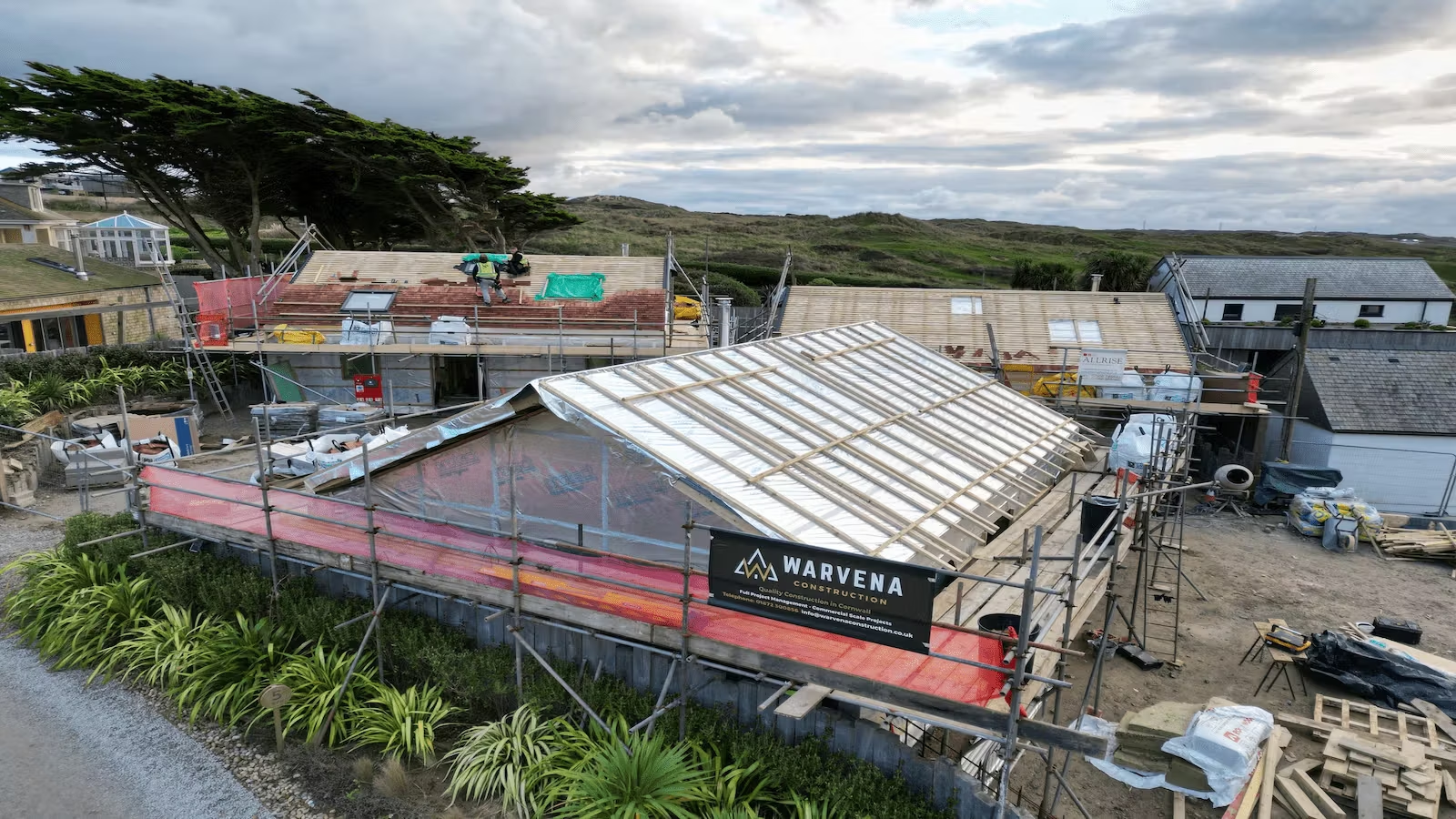
Programme, Cost & Governance at Warvena Construction
Programme
A realistic construction timeline developed for the specific site and design — not adapted from a template. On exposed Cornish coastal sites, programme includes seasonal weather planning, long-lead procurement windows, and pre-commencement condition discharge timescales. On The Ark at Constantine Bay, PCSA programme work at RIBA Stage 2 identified the bespoke coastal glazing lead time early enough to align the order with planning consent — protecting the weather-tight milestone the entire interior fit-out depended on.
Cost
Accurate cost planning against current Cornish market rates — not national benchmarks. Cornwall's supply chain distance, specialist trade availability, and coastal material uplifts are factored in from the first cost plan. This prevents the budget shock that most commonly hits at tender stage, when the design is frozen and redesign is expensive.
Governance
Clear decision-making, defined scope, and transparent reporting throughout the pre-construction phase. The client always knows where the project stands — on cost, on programme, on risk. There are no surprises at the end of the PCSA phase, because the process is designed to surface and resolve issues continuously, not to bank them for handover.
When does a PCSA make sense for your Cornwall project
Not every project needs a formal PCSA. But for most bespoke Cornish new builds, a PCSA pays for itself many times over. These are the conditions where it adds most value:
Complex or sensitive sites
AONB locations, coastal sites, steeply sloping ground, granite bedrock, or sites with pre-commencement planning conditions. The risk factors that make Cornwall's most desirable plots expensive to build on are exactly the conditions a PCSA is designed to manage.
High-performance specifications
Passive House, high-airtightness, or Future Homes Standard builds where design and construction are tightly interdependent. Getting the contractor's input on airtightness strategy, MVHR integration and thermal bridge detailing at design stage is essential, not optional.
Budget certainty is critical
If you are financing the build, living in rented accommodation during construction, or managing a phased project where cost overruns have serious consequences, the cost certainty a PCSA provides is worth the fee many times over.
First-time self-builders
If this is your first bespoke project, a PCSA gives you a trusted experienced contractor in the room during the design phase — someone whose interests are aligned with making the project buildable and affordable, not just beautiful.
Looking for PCSA Services in Cornwall?
Warvena Construction provides Pre-Construction Services Agreements for bespoke new builds, Passive House projects, and coastal homes across Cornwall. TrustMark registered.
Get in touch to discuss your project → info@warvenaconstruction.co.uk
Frequently Asked Questions About PCSA Agreements
What does PCSA stand for in construction?
PCSA stands for Pre-Construction Services Agreement. It is a formal contract that engages a contractor to provide services during the design phase of a project — before the main construction contract is signed. These services typically include cost planning, buildability review, programme development, and procurement strategy.
Why are PCSA agreements used in construction?
PCSAs are used to bring a contractor’s practical knowledge into the design process before it’s too late to act on it. Most of a project’s cost is shaped by early design decisions. A contractor involved at RIBA Stage 2 can flag cost implications, identify long-lead material issues, and resolve buildability problems while they can still be addressed on paper — not on site at full construction cost.
Does a PCSA commit me to using the same contractor for the build?
No. A PCSA is not a building contract. It engages a contractor for pre-construction services only. At the end of the pre-construction phase, you decide whether to proceed with the same contractor, go to open tender, or pause the project. The PCSA does not bind you to the main works in any way
Do PCSA agreements reduce project delays?
Yes — significantly. Most construction delays are predictable: incomplete design information, long-lead procurement items discovered too late, planning conditions not mapped in advance, and scope changes caused by unresolved design queries. A PCSA addresses all four. In Cornwall specifically, managing ecology survey windows, AONB pre-commencement conditions, and specialist supply chain lead times during the pre-construction phase is the most effective way to protect your programme.
How do PCSAs support cost management?
A PCSA provides accurate, current-market cost information at the design stage — before the design is frozen and before you're committed to a contractor. In Cornwall, national cost benchmarks consistently underestimate local build costs. Supply chain distance, specialist trade availability, and coastal specification uplifts all push Cornwall costs above national averages. Getting Cornwall-specific cost input at RIBA Stage 2 prevents the budget shock that most often hits at tender stage.
Are PCSA agreements common in high-end residential construction?
Yes, and increasingly so. High-end residential projects — particularly Passive House builds, architect-designed coastal homes, and complex bespoke new builds — involve specialist materials, long lead times, and tight interdependencies between design and construction that make early contractor involvement essential. PCSAs are now standard practice on high-specification Cornish new builds where cost certainty, programme protection, and buildability matter from the outset
THINKING ABOUT A HIGH-PERFORMANCE BUILD IN CORNWALL?
Warvena Construction are TrustMark registered builders based in Redruth, Cornwall, and members of the AECB. We work across Cornwall with private clients, architects, and developers on bespoke new builds, Passive House projects, coastal renovations, and commercial construction.