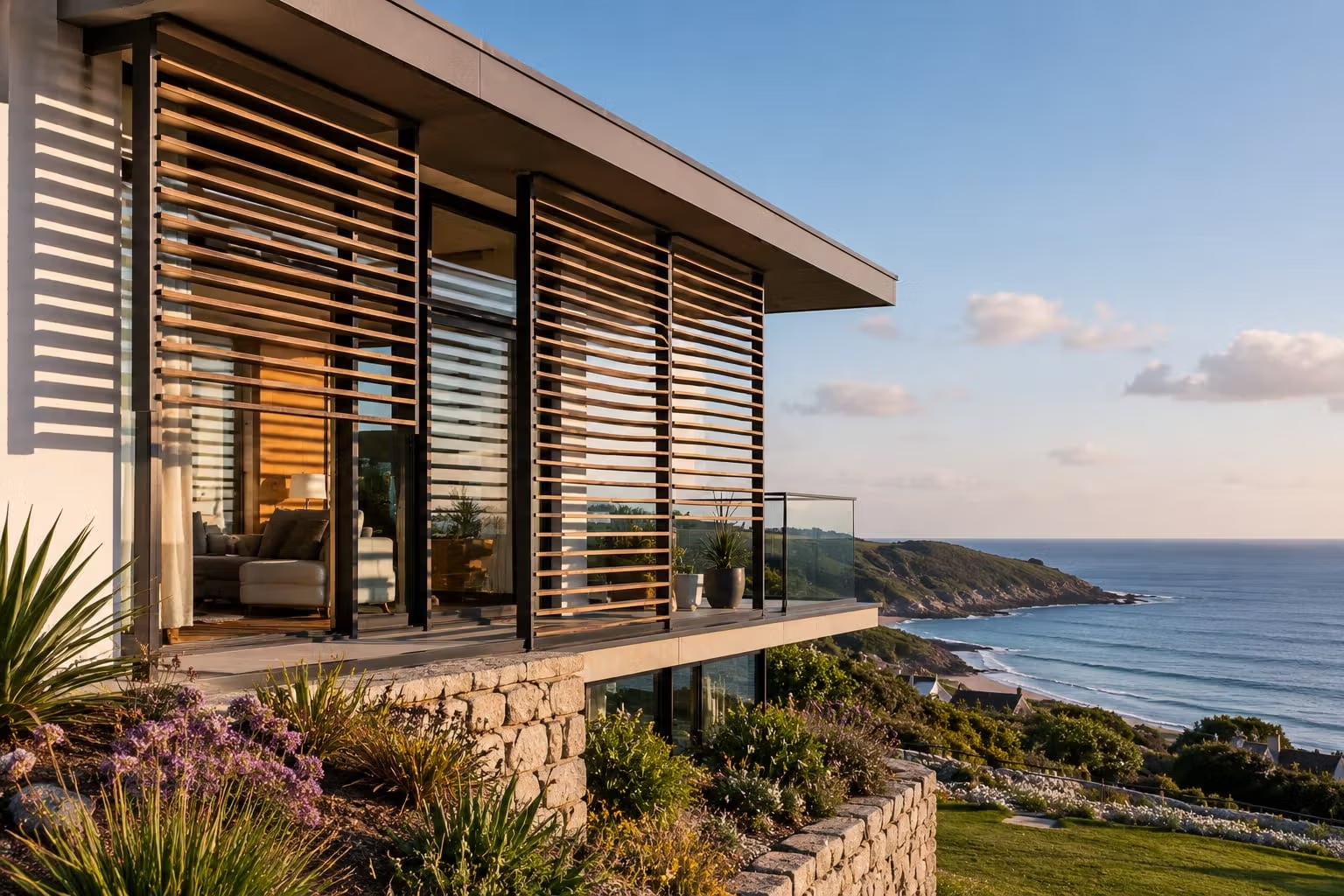
There's a design problem that catches a surprising number of clients off guard. You commission a home with generous south-facing glazing — the views, the light, the connection to the landscape are exactly what you wanted. Then the first summer arrives and the living room becomes uninhabitable by midday.
External shading is far more effective than internal blinds because it intercepts solar heat before it enters the building. Brise-soleil does exactly that — and it does it passively, with no moving parts, no energy consumption, and no effect on your winter solar gain. The same façade that shields your home from July heat welcomes January sun beneath its louvres
Brise-Soleil Meaning
A brise-soleil (French for "sun breaker") is an external architectural shading system engineered to control the solar energy entering a building through its glazing. Using a series of precisely angled louvres, fins or slats, it acts as a physical shield against the high-angle summer sun — while allowing the low-angle winter sun to pass beneath it and reach deep into the interior.
The geometry is the key. In the UK, the summer sun reaches its peak elevation of around 60° above the horizon at noon. In winter that drops to around 15°. A correctly specified brise-soleil is angled precisely to intercept the summer arc and pass the winter arc — using the sun's own seasonal movement as the switching mechanism. No sensors, no motors, no energy.
The same façade rejects heat in July and welcomes it in January. That's not a coincidence — it's trigonometry.
For Passive House builds in Cornwall, brise-soleil is not an aesthetic choice. It is a performance component. Passive House buildings allow for space heating and cooling related energy savings of up to 90% compared with typical building stock — but only when solar gains are managed correctly. Overheating is the failure mode that undermines the standard's comfort promise, and external shading is the primary tool for preventing it.
Why brise-soleil is now a regulatory requirement — not just a design choice
This is the section most blogs on this topic miss entirely.
Part O of the Building Regulations was introduced to tackle overheating — an increasing issue in modern airtight homes. The regulation requires all new dwellings to be assessed for overheating risk and to incorporate effective mitigation strategies.
The simplified method in Approved Document O limits south-facing glazing to as little as 11–15% of floor area in higher-risk locations, depending on cross-ventilation availability. For a home with generous south-facing glazing — which describes most of the bespoke Cornish homes Warvena build — that threshold is easily exceeded. The result: either restrict the glazing, or demonstrate compliance through dynamic thermal modelling with robust mitigation in place. Designing Buildings
Brise-soleil is one of the primary mitigation measures Approved Document O recognises. External shading — overhangs, brise-soleil, deep window reveals, and external shutters or blinds — is the most effective way to block direct solar radiation. Designing Buildings
The Future Homes Standard, coming into force from March 2027, tightens this further. As homes become more airtight and better insulated, managing solar gain becomes more critical — not less. Part O (Overheating) is increasingly vital as we build more airtight, highly insulated homes. Local Government Lawyer
The practical implication: if you are designing a bespoke Cornish home with generous glazing today, brise-soleil is not a premium addition — it is increasingly a compliance requirement and a performance necessity.
The Brise-Soleil Shading System: Fixed vs. Dynamic Options
To specify the right external shading strategy for a brise soleil UK project, you need to weigh the structural simplicity of fixed louvres against the responsive performance of automated systems.
Fixed Brise-Soleil
- How It Functions: Set structural blades angled permanently to block high summer sun while letting low winter sun slip beneath them.
- Ideal Architectural Application: Best for pure south-facing glazing where the sun's path is predictable year-round. Zero maintenance, lower cost.
Dynamic / Motorised
- How It Functions: Automated louvres that rotate through the day via solar-tracking sensors or smart-home automation.
- Ideal Architectural Application: Essential for complex southwest or west-facing façades where glare and heat spikes vary sharply between afternoon and dusk.
Fixed vs motorised brise-soleil — which is right for your project?
Fixed brise-soleil
Fixed louvres are set at a permanent angle calculated for the specific orientation and latitude of the site. For pure south-facing glazing in Cornwall, they are the most cost-effective and most reliable solution — zero maintenance, zero moving parts, and a shading performance that is precisely matched to the sun's seasonal path.
The limitation is inflexibility. On a fixed system, the louvre angle is optimised for one orientation. If the glazing has significant east or west component — or if the client wants to modulate light levels independently of the sun's position — a fixed system cannot respond.
Motorised / dynamic brise-soleil
Automated louvres that rotate through the day via solar-tracking sensors or smart-home integration offer responsive performance across complex façade geometries. For south-west or west-facing glazing — where afternoon glare and heat spikes vary sharply between summer and winter — a motorised system adapts in real time where a fixed system cannot.
The trade-off: mechanical complexity, maintenance requirements, and higher upfront cost. On a Cornish coastal site, motorised systems also require additional specification attention — salt air and Atlantic gales are hostile to exposed mechanisms.
The Warvena recommendation for most Cornwall builds: fixed brise-soleil on south-facing elevations, motorised on west-facing elevations where afternoon solar control matters. Specify the shading geometry alongside the glazing — never after.
Technical specification for Cornwall's coastal environment
This is where generic brise-soleil guides diverge sharply from what a Cornish coastal site actually demands. The following are not optional refinements — they are baseline requirements for any exposed coastal location.
Atlantic wind loading
An exposed coastal site in Cornwall can experience wind pressures well above the national design standard. A brise-soleil on an exposed clifftop elevation behaves exactly like a sail — it presents a large surface area perpendicular to the prevailing south-westerly. Mounting brackets must anchor directly into the building's primary structural frame — timber studs or steel — never into the external cladding or insulation layer alone. Marine-grade stainless steel fixings throughout. This is not a detail to value-engineer.
Material durability in salt air
Salt-laden air accelerates corrosion of aluminium, steel and timber at a rate that inland specifications do not account for. The choices that perform on a Cornish coastal site:
Timber — Western Red Cedar, Siberian Larch, or modified timber (Accoya) handle repeated wetting and drying cycles without twisting or splitting. Untreated softwood will fail within a few seasons on an exposed coastal site.
Aluminium — Marine-grade powder-coated aluminium with appropriate coating thickness (minimum 60 microns) and sealed cut ends. Standard architectural aluminium coatings are insufficient within 500 metres of the sea.
Stainless steel fixings — Grade 316 stainless steel throughout. Grade 304, used in standard inland applications, will show surface corrosion within two to three years in a marine environment.
Thermal isolation — the detail most builders miss
The structural arms that support the brise-soleil must penetrate the external insulation layer to reach the building's primary structure. Every penetration is a thermal bridge — a conductive path between the warm interior and the cold exterior. On a Passive House build, uncorrected thermal bridges undermine the airtightness strategy and create cold spots where condensation forms behind finished surfaces.
The fix is straightforward when specified early: thermal isolator pads behind the mounting plates, breaking the conductive path. Retrofitting this detail after cladding is installed is expensive. Designing it in at RIBA Stage 2 costs almost nothing.
When to specify brise-soleil — and why timing matters
The most cost-effective moment to design brise-soleil into a project is at RIBA Stage 2, alongside the glazing specification. The louvre geometry, structural fixing strategy, and thermal isolation details all interact with the glazing system, the cladding build-up, and the structural frame. Designing them together costs nothing extra. Retrofitting structural external shading to a completed façade — cutting through cladding, installing structural fixings, replastering cold bridge remediation — can cost several times the original installation.
On Warvena builds, we flag brise-soleil as a Stage 2 design decision on any project with south or west-facing glazing above Part O thresholds. It is consistently cheaper to design it in than to value-engineer it out and address the overheating consequences later.
Frequently Asked Questions
Does a brise-soleil block my view or make rooms darker?
No — that's the elegance of it. The louvres are angled to intercept high summer sun while leaving your sightline through the glass clear. You keep the view and the daylight; you lose only the unwanted overheating
Fixed or motorised — which is better for a Cornish coastal home?
It depends on orientation. A fixed system is ideal and virtually maintenance-free on true south-facing glazing. For southwest or west elevations, where low afternoon sun causes sharp glare and heat spikes, a motorised tracking system earns its extra cost.
Will a brise-soleil survive Atlantic storms and salt exposure?
Yes, when correctly specified. The system must anchor into the primary structural frame with marinegrade stainless fixings, and use corrosion-resistant materials — powder-coated aluminium or stable modified timbers like Accoya. Detailing, not the product alone, determines coastal longevity
Can a brise-soleil be added to an existing house?
It can, but it's best designed in from the outset. Structural fixings and thermal isolators are far simpler — and cheaper — to detail before the façade and insulation are complete. Talk to us early if you're at the design stage.
THINKING ABOUT A HIGH-PERFORMANCE BUILD IN CORNWALL?
Warvena Construction are TrustMark registered builders based in Redruth, Cornwall. Listed on the Passivhaus Trust directory and members of the AECB, we work across Cornwall with private clients, architects, and developers on bespoke new builds, Passive House projects, coastal renovations, and commercial construction.