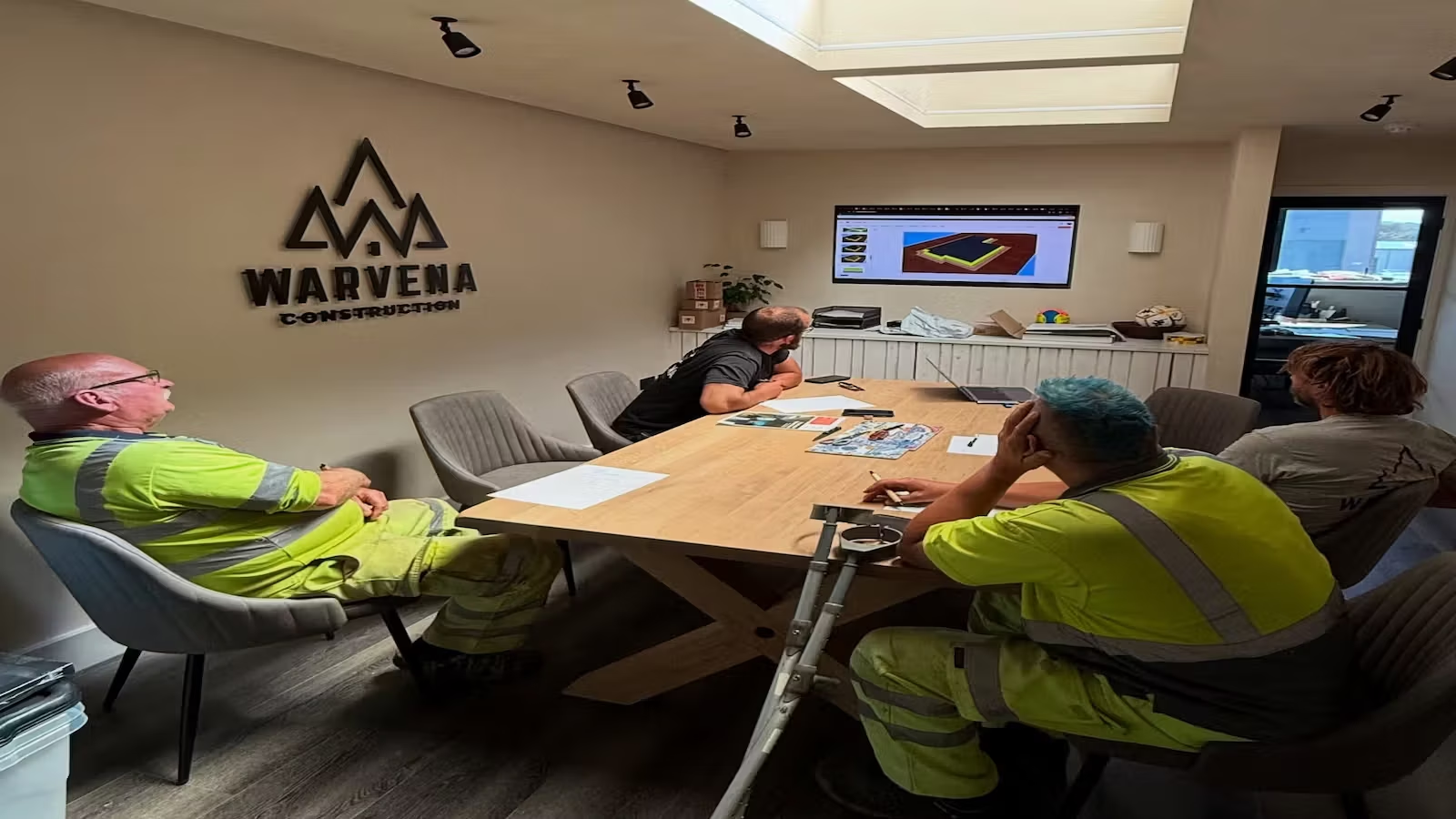
Want to prevent your construction project from running over budget or hitting unexpected delays? The secret is simple: bring your builder to the design table early.
Known as Early Contractor Involvement (ECI), this collaborative approach aligns your architect’s vision with real-world building costs and supply chains. By solving structural and budgeting issues on paper, we ensure that when your permits drop, construction starts smoothly without any expensive surprises.
What Is Early Contractor Involvement — and Why Does It Matter?
Conventionally, homeowners hand finished architectural drawings to a builder and just hope for the best. Early Contractor Involvement (ECI) changes that. It gives the person actually building your home a seat at the design table long before anyone breaks ground.
In the UK, waiting until the last minute to hire a builder is still the norm, but it almost always leads to the same headaches:
- Designs that look beautiful on paper but are impossibly expensive to build.
- Materials chosen for looks rather than how they actually perform over time.
- Sudden site delays because the building steps weren't planned in order.
- Budgets based on outdated guesses instead of real-time material costs.
Fixing a mistake on a drawing costs next to nothing; fixing it mid-build can break a budget.
If you are planning a bespoke renovation, an extension, or a highly technical Passivhaus build here in Cornwall, getting your builder involved early isn't just a good idea—it’s your best insurance policy. When the stakes are this high, your architect's vision and your builder's real-world execution need to be completely in sync from day one.
PCSA Agreements Explained — and Why They Protect You?
A Pre-Construction Services Agreement (PCSA) is the formal mechanism for early contractor involvement. It's a contract that engages a contractor to provide pre-construction services before a main construction contract is signed.
What a PCSA covers:
- Preliminary cost estimates and cost plan development.
- Programme and phasing advice.
- Buildability and value engineering reviews.
- Input on materials, specifications, and supply chain.
- Early procurement of long-lead items.
- Risk identification, surveys, and ground investigations management.
Why it protects clients:
A PCSA gives you contractor expertise during the period when it's cheapest to act on it. It also creates a defined relationship and clear scope — you're not relying on informal conversations or goodwill. For contractors, it provides fair compensation for substantive pre-construction work. For clients, it means a contractor who is genuinely invested in a project's success before construction begins.
Note: A PCSA is not a building contract. It doesn't commit you to appointing that contractor for the main works. But it does mean that when you get to that point, you'll have accurate, realistic cost information — not a speculative tender figure.
For projects involving Passivhaus certification, complex coastal conditions, or significant structural work, a PCSA is invaluable. These technical requirements demand early clarity on airtightness strategies, thermal detailing, and specialist material sourcing.
Feasibility & Buildability — Is Your Design Actually Constructible?
Feasibility and buildability are related but distinct concepts:
- Feasibility asks: Can this project be delivered within the client's constraints of budget, programme, and planning?
- Buildability asks: Can this design actually be constructed efficiently and to the required quality?
Architects are trained to design. Contractors are trained to build. These are different disciplines, and the gap between a beautiful design and a buildable one can be significant — especially in projects with unusual geometries, challenging site conditions, or high-performance specifications.
Common buildability issues caught early:
- Structural details that are technically compliant but awkward to execute in the field.
- Junctions between materials that look clean on drawings but create thermal bridging or airtightness risks in practice.
- Programme sequencing that assumes trade operations can happen in parallel when they cannot.
- Cost estimates based on standard specifications when the project requires bespoke solutions.
A buildability review at RIBA Stage 2 or 3 is significantly cheaper than a redesign at Stage 4 — and incomparably cheaper than remediation on site. A feasibility study at the earliest stage helps clients make informed go/no-go decisions based on true costs (including preliminaries and contingencies) before committing heavily to detailed design.
Contractor Input at the Design Stage — Where It Adds Most Value?
The design stage is where a contractor's input delivers the greatest return, yet it's also the stage at which most contractors are absent.
Cost-driving decisions happen at design stage
Approximately 80% of a project's cost is determined by design decisions. The choice of structural system, material specifications, the complexity of the building form, and the approach to services integration lock in costs far more than anything that happens during procurement or construction. A contractor who understands the cost implications of design choices against current market rates is an invaluable resource here.
Specialist subcontractor input
For technically demanding packages — such as Passivhaus-compliant Mechanical Ventilation with Heat Recovery (MVHR), structural steelwork, specialist glazing, or renewable energy systems — early engagement surfaces critical supply chain constraints.
Discovering a bespoke window system has a 24-week lead time after planning consent is granted creates a major programme delay. Discovering it at RIBA Stage 2 allows you to design around it.
The contractor's role at the design stage is not to constrain the architect's vision — it's to make that vision deliverable.
Inspection Before Concealment — What Gets Missed and Why?
Inspection before concealment is one of the most critical quality control processes in construction. The principle is straightforward: critical elements of a building's fabric must be inspected and approved before they are covered up by subsequent works.
Once an element is concealed, verification becomes extremely difficult, expensive, or impossible. A poorly installed vapour control layer buried beneath insulation and plasterboard cannot be corrected without stripping back finished work. An airtightness membrane that hasn't been properly taped at junctions will undermine a building's thermal performance for its entire life.
What should be inspected before concealment?
In high-performance buildings, the pre-concealment checklist must include:
- Structural connections, fixings, and embedment.
- Insulation continuity and alignment.
- Airtightness membrane installation, lapping, and taping at all penetrations.
- Vapour control layer integrity.
- Services runs, penetration sealing, and fire stopping.
- Drainage gradients and pipe bedding.
- Damp proof courses (DPC) and cavity tray details.
On Passivhaus projects, airtightness testing before and after second fix is standard practice precisely because it catches defects while they can still be remedied at a reasonable cost.
How to Avoid Construction Delays Before They Happen
Construction delays are rarely random. Most are predictable — and preventable — when the right planning is in place before work starts.
Common Cause of DelayHow Pre-Construction Mitigates ItIncomplete Design InformationECI establishes a clear Information Release Schedule agreed upon by the design team and builder before breaking ground.Long-Lead Procurement IssuesIdentifies items like structural steel, specialist glazing, or MVHR units early to secure orders well ahead of the master programme.Third-Party/Utility DelaysMaps out timescales for utility connections, building control inspections, and planning conditions early rather than reacting on site.Scope Creep & Site ChangesStress-tests the brief and resolves structural/design queries on paper, significantly reducing changes during construction.
Future-Proofing Your Build From Day One
A building should serve its owners well across its entire life. Future-proofing — designing and building to accommodate change, reduce running costs, and extend useful life — is most effectively addressed at the pre-construction stage.
- Structural Flexibility: Designing for structural flexibility (e.g., oversizing spans slightly, avoiding unnecessary internal load-bearing walls, and installing spare conduit routes) costs relatively little during construction but saves significantly over a building's lifetime.
- Services & Energy Infrastructure: The rapid evolution of domestic energy systems (heat pumps, battery storage, EV charging, solar PV) means provision for future services is a necessity. Installing appropriate cable routes and consumer unit capacity during construction is a fraction of the cost of retrofitting them later.
- Material Durability: In coastal environments like Cornwall, where salt air accelerates corrosion, material selection is a long-term financial decision. A contractor with genuine coastal experience will specify materials that perform over decades, not just on the day of handover.
For Passivhaus and high-performance builds, future-proofing is already baked into the design philosophy: a building that uses 75–90% less energy than a conventional equivalent is future-proofed against energy price volatility by definition.
Frequently Asked Questions
What is a PCSA agreement?
Pre-Construction Services Agreement (PCSA) is a contract that brings a contractor into a project before the main build contract is signed — usually during the design phase. It lets the builder advise on buildability, cost, and programme without either party committing to the full build yet.
Why should I involve a builder early in the design stage?
Early Contractor Involvement (ECI) catches buildability issues while changes are still cheap — on paper, not on site. It also locks in realistic cost and programme estimates before formal tendering.
How does early involvement reduce construction delays?
Most delays come from issues that could have been spotted earlier: clashes between trades, missing design information, or unrealistic sequencing. A contractor involved at the design stage flags these before they hit the site timeline.
What is a buildability and feasibility review?
It's a contractor-led check of whether the design can actually be built safely, within budget, and on time — taking into account the realities of materials, specialist labour, and site access.
Why is inspection before concealment important?
Once work is covered up — plastered over, boxed in, or backfilled — defects become incredibly expensive to find and fix. Inspecting before concealment protects build quality and prevents structural or energy-loss disputes later.
What does "future-proofing" mean in construction?
It means designing and building so the property can effortlessly adapt to future needs — such as future extensions, green energy upgrades, smart home systems, or changing building regulations — without requiring costly, destructive rework.
When is the best time to bring Warvena Construction into a project?
As early as possible — ideally at the concept phase or RIBA Stage 2/3. We work under PCSA arrangements so you gain our technical buildability input without committing to a full building contract upfront.
THINKING ABOUT A HIGH-PERFORMANCE BUILD IN CORNWALL?
Warvena are TrustMark registered, Passivhaus-experienced builders based in Redruth. We work across Cornwall with architects, developers and private clients to deliver homes that perform.