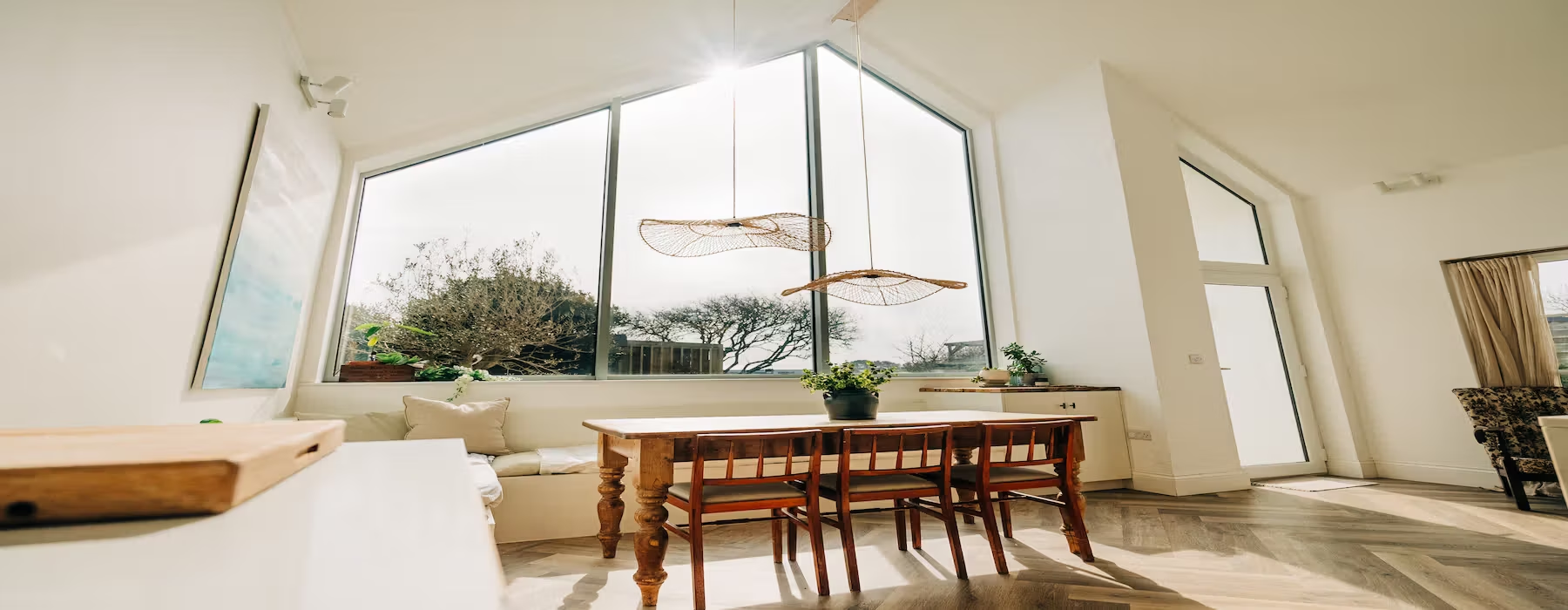
In traditional UK home construction, windows are treated like structural holes that leak heat. You design a beautifully insulated wall, only to cut apertures into it and install standard glazing systems that account for up to 80% of the property's total thermal loss.
When building a high-performance home or targeting certified Passivhaus standards, this approach changes entirely.
Passive House glazing isn't a passive structural weak point — it is an active engineering component. When properly specified, oriented, and detailed, modern high-performance windows act as netpositive solar radiators, harvesting more thermal energy from the sun over a year than they lose to the cold Cornish elements outside.
Read more about our Passive House builds in Cornwall.
Beyond the Third Pane: Passive House Windows
Many self-builders and developers assume that "Passive House glazing" is simply standard triple glazing with a different marketing label. In reality, a certified Passivhaus window assembly relies on a hyper-engineered combination of materials working together to break thermal bridging.
A true Passivhaus window system consists of four distinct engineering elements:
1. Low-E (Low-Emissivity) Coatings — Microscopically thin metal-oxide layers on the internal glass faces. They let short-wave solar radiation (light and warmth) in, but block long-wave infrared heat from escaping back out.
2. Noble Gas Cavities — The spaces between the three panes are filled not with air but with dense, non-reactive Argon or Krypton, drastically slowing convective heat transfer inside the unit.
3. Warm-Edge Spacers — Standard double glazing uses aluminium strips that conduct cold straight across the pane edge. Passivhaus units use structural foam or composite warm-edge spacers to separate the glass without bridging the cold.
4. Insulated Frame Profiles — A window is only as good as its frame. Passivhaus frames use deep, multi-chambered profiles packed with insulation (cork, foam, or engineered timber cores) to match the thermal resistance of the glass itself.
Understanding the Physics: U-Values vs. G-Values
To confidently specify glazing for a high-performance design in Cornwall, you must balance two competing metrics: U-values and g-values.
The U-Value (Thermal Transmittance)
The U-value measures how much heat escapes through a material — the lower the number, the better the insulation.
- Standard UK Building Regulations typically accept window U-values around 1.2–1.4 W/m²K.
- To achieve Passivhaus certification, the installed window assembly (glass and frame combined) must reach a maximum U-value of 0.80 W/m²K or lower.
The G-Value (Solar Factor)
The g-value measures the percentage of solar energy that passes through the glass to warm the rooms, expressed as a decimal between 0 and 1.
A g-value of 0.50 means 50% of the sun's available heat penetrates the envelope. In cooler UK climates, balancing high insulation (low U-value) with healthy solar gain (g-value around 0.50–0.60) lets the home heat itself naturally through winter — without leaning on a traditional central boiler.
The G-Value (Solar Factor)
The g-value measures the percentage of solar energy that can physically pass through the glass to warm the interior rooms. It is expressed as a decimal between 0 and 1.
A g-value of 0.50 means 50% of the sun’s available heat energy penetrates the building envelope. In cooler UK climates, balancing high insulation (low U-value) with balanced solar heat gain (g-value around 0.50 to 0.60) allows the home to heat itself naturally during winter months without requiring a traditional central boiler system.
The Cornwall Complexity: Wind, Salt, and Solar Overheating
Designing a high-performance property along the Cornwall coast introduces unique environmental factors that directly influence how glazing layouts must be detailed during the early design stages.
1. Marine Structural Loads & Exposure
Atlantic-facing sites endure extreme wind pressures and airborne salt crystallisation. Glazing specified for exposed Cornish landscapes must offer exceptional structural stability and high-grade external protection — such as marine-grade powder-coated aluminium exterior faces over a warm timber structural core (known as alu-clad timber frames).
2. Preventing Summer Overheating
Because Passivhaus windows are exceptionally good at trapping heat, large south- or west-facing expanses of glass can easily overheat a building in mid-summer.
The fix is proactive solar shading: calculated roof overhangs that block high-angle summer sun while admitting low-angle winter sun, or mechanical brise-soleil / external venetian systems. This is a design-stage decision — which is why it pays to involve your builder early
Installation Detailing: Where Performance Succeeds or Fails
You can buy the most expensive certified window in the world, but install it badly into the rough opening and its performance collapses.
In Passivhaus construction, the window frame must sit within the insulation layer of the wall — not flush with the external masonry or timber wrap. The entire perimeter is then meticulously sealed with specialist airtightness tapes and expanding insulation compounds.
Any uninsulated frame edge or minor gap creates a localised thermal bridge. That doesn't just drop room efficiency — it lowers the internal surface temperature of the frame, creating an instant point for condensation and moisture tracking behind the plasterboard. This is precisely the kind of detail our team at Warvena resolves on every high-performance build in Cornwall.
Frequently Asked Questions
Can I just use standard off-the-shelf triple glazing instead of certified Passivhaus windows?
While high-quality standard triple glazing offers decent insulation, it rarely meets strict Passivhaus criteria. Certified assemblies are tested to ensure the entire unit — insulated multi-chamber frame, warm-edge spacers, and gas fillings — reaches a combined U-value of 0.80 W/m²K or lower. Standard units often have well-insulated glass but weak, uninsulated frames that create major thermal bridges
How do you stop large Passivhaus windows from overheating in the summer?
Because Passivhaus glazing is exceptionally efficient at trapping heat, managing summer solar gain is critical. This is handled by integrating architectural shading during the design stage. Solutions include calculated roof overhangs, structural timber louvers, or automated external blinds (brise-soleil) that block out high-angle summer sun while still allowing low-angle winter sun to penetrate and heat the home naturally.
Why is window installation detailing so critical in high-performance builds?
Because the window only performs as well as its junction with the wall. The frame must sit within the insulation layer and be fully sealed with airtightness tapes — any uninsulated edge or gap creates a thermal bridge that lowers efficiency, drops the internal frame temperature, and triggers condensation behind the plasterboard. Flawless detailing is the difference between a certified result and a mouldy reveal. See how we approach technical detailing in Cornwall ↗
Do Passivhaus windows work well in exposed coastal locations like Cornwall?
Yes — provided they're specified for the environment. Atlantic exposure demands high structural stability against wind load and corrosion resistance against airborne salt. The proven solution is aluclad timber frames: a warm engineered-timber core for thermal performance, with a marine-grade powder-coated aluminium outer face to withstand the coastal climate.
THINKING ABOUT A HIGH-PERFORMANCE BUILD IN CORNWALL?
Warvena are TrustMark registered, Passivhaus-experienced builders based in Redruth. We work across Cornwall with architects, developers and private clients to deliver homes that perform.